
Fighting Styles
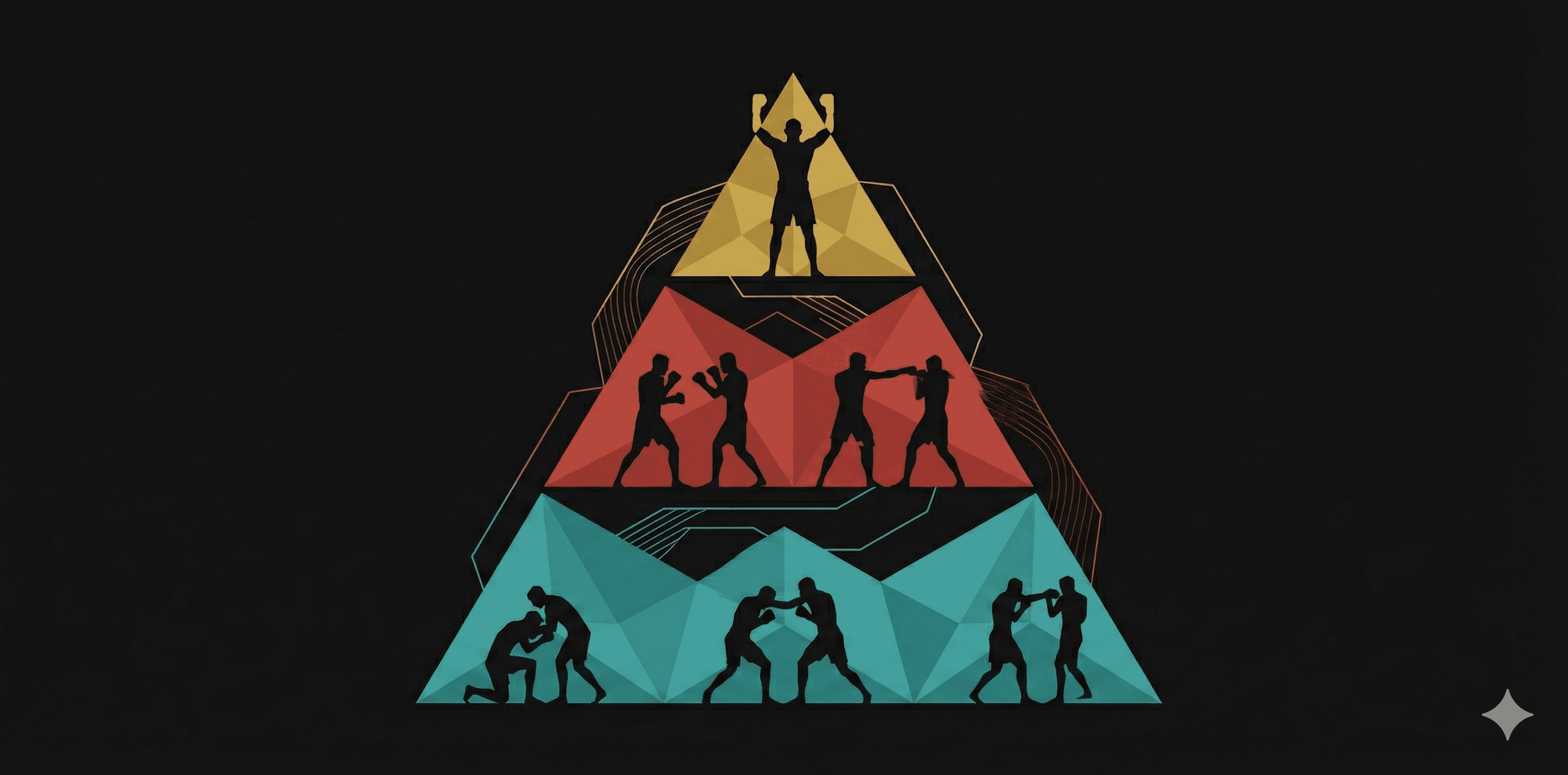
Every UFC fighter is classified into one of five fighting styles: Wrestler, Grappler, Kicker, Striker, or Balanced. Styles are determined automatically from career statistics and provide insight into how a fighter approaches their bouts.
Style Overview
| Style | What It Means |
|---|---|
| Wrestler | Dominant wrestling and control — wins by taking opponents down and keeping them there |
| Grappler | Submission-oriented ground game — threatens finishes on the mat through chokes and locks |
| Kicker | Leg strike specialist — uses leg kicks as a primary weapon to damage and slow opponents |
| Striker | Stand-up specialist — fights primarily at distance using punches and head/body strikes |
| Balanced | Well-rounded mixed martial artist — no single dominant tendency |
How Classification Works
Style classification is based on a fighter's career averages across key statistical categories. The system checks each style in priority order — the first match wins.
Priority Order
Wrestler -> Grappler -> Kicker -> Striker -> Balanced (default)
A fighter can only have one primary style. If they meet criteria for multiple styles (e.g., both Wrestler and Kicker thresholds), they're classified as whichever comes first in the priority order.
Wrestler
Wrestlers are defined by high takedown volume combined with extended ground control. These fighters build their game around putting opponents on the mat and controlling them there.
| Criterion | Threshold |
|---|---|
| Avg Takedowns Landed | > 2.5 per fight |
| Avg Control Time | > 2:00 per fight |
Both conditions must be met. A fighter who gets takedowns but can't hold position (low control time) won't qualify, and a fighter who controls on the feet through clinch work but rarely takes down won't qualify either.
Example: Khabib Nurmagomedov — averaging 4.7 takedowns per fight with 6:31 of control time. The prototypical Wrestler who smothers opponents with relentless pressure wrestling.
Grappler
Grapplers are submission threats or ground controllers who don't have the wrestling volume to qualify as Wrestlers. There are two paths to this classification:
Path A — Submission Specialist:
| Criterion | Threshold |
|---|---|
| Avg Submission Attempts | > 0.8 per fight |
High submission activity alone qualifies a fighter as a Grappler regardless of other stats.
Path B — Control-Based Grappler:
| Criterion | Threshold |
|---|---|
| Avg Control Time | > 2:30 per fight |
| Avg Takedowns Landed | 1.0 to 2.5 per fight |
| Distance Strike % | < 65% |
This path catches fighters who control on the ground through trips, pulls, and clinch takedowns rather than explosive wrestling shots. The distance strike guard prevents misclassifying distance strikers who happen to have moderate grappling output.
Example: Jon Jones — averaging 2.0 takedowns per fight with 3:39 of control and 0.5 submission attempts. A Grappler who mixes takedowns with submission threats.
Kicker
Kickers are fighters who devote a significant portion of their striking output to leg attacks. Leg kicks are a distinct strategic weapon — they limit opponent mobility, set up other strikes, and accumulate damage that compounds over rounds.
| Criterion | Threshold |
|---|---|
| Leg Strike % | > 25% of total strikes |
This is the only requirement. A fighter who throws a quarter or more of their strikes to the legs has a clear kicking-focused approach, regardless of their other stats.
Example: Israel Adesanya — 43.2% of strikes targeting the legs, with 96.9% of strikes from distance. A Kicker who uses range and leg attacks to control fights.
Striker
Strikers fight primarily from distance using punches, elbows, and head/body kicks. They avoid grappling exchanges and prefer to keep the fight standing.
| Criterion | Threshold |
|---|---|
| Avg Takedowns Landed | < 2.0 per fight |
| Distance Strike % | > 60% of total strikes |
Both conditions must be met. The low takedown threshold confirms the fighter isn't wrestling, while the high distance percentage confirms they're working from range rather than in the clinch or on the ground.
Note: This category previously had a separate "Boxer" sub-style for head-focused distance strikers. Analysis showed less than 2.5 percentage points difference in matchup outcomes between Boxers and other Strikers, so the categories were merged. The Boxing tendency is still tracked as a secondary style.
Example: Conor McGregor — high distance striking percentage with minimal takedown attempts. A classic Striker who looks to finish fights on the feet.
Balanced
Balanced is the default classification for fighters who don't clearly fit any of the four specialist styles. This includes:
- True all-rounders who mix striking, wrestling, and submissions without leaning heavily on any one area
- Fighters with unusual stat profiles that don't match standard patterns
- Newcomers whose limited sample size hasn't yet revealed a dominant tendency
Being classified as Balanced isn't a weakness — many of the most successful UFC fighters are well-rounded and adapt their approach to each opponent.
Secondary Styles (Hybrid Fighters)
In addition to their primary style, fighters can have a secondary style that identifies a notable tendency that didn't dominate enough to become their primary classification. Secondary styles use lower thresholds:
| Secondary Style | Criteria |
|---|---|
| Wrestling | Avg takedowns > 1.5 AND control time > 1:00 |
| Grappling | Avg submission attempts > 0.5 |
| Kicking | Leg strike % > 15% |
| Boxing | Distance strike % > 65% |
A fighter might be classified as "Striker (Wrestling)" — primarily a stand-up fighter who also has meaningful wrestling in their game. The secondary style adds nuance beyond the primary label.
How Styles Affect Predictions
Fighting style plays a role in the prediction model through style matchup adjustments. Historical data shows that certain style matchups produce predictable advantages:
- How does a Wrestler typically fare against a Striker?
- Do Grapplers have an edge over Kickers?
- Are Balanced fighters harder to game-plan for?
Each fighter's historical win rate against their opponent's style is factored into the prediction, capped at a modest adjustment to prevent small-sample distortions. A fighter who is 5-0 against Wrestlers gets credit for that, but the boost is limited since five fights is still a small sample.
Style vs. Tier
Style and tier are independent classifications:
- Style answers: "How does this fighter fight?" (Wrestler, Striker, etc.)
- Tier answers: "How good is this fighter?" (Elite, Mid, Low)
A Wrestler can be Elite, Mid, or Low. An Elite Striker faces different challenges than a Low Striker, even though their approach is similar. The prediction model considers both dimensions — a fighter's stylistic matchup AND their quality tier — to produce its final probability.